Everyday Safety Tips for Families & Students
September 17, 2026
Most safety advice is written as a warning. Warnings are memorable for an afternoon and then they fade. What actually keeps a family safe is a small set of things done the same way every time, so that nobody has to think clearly in the moment when thinking clearly is hardest.
This is about the twenty minutes of preparation that do most of the work.
The one page that matters most
Every household needs a single page that answers three questions in a hurry: who do we call, where do we live, and what does someone need to know about us. Everything else is detail.
What belongs on it
- Emergency numbers for your country, written in large type, not saved only in a phone.
- Two people outside the household who can be called and will answer.
- Your address written out, plus the nearest landmark. Children under stress forget their own street.
- Medical notes: allergies, medication, anything a paramedic should know in the first minute.
Print it, fill it in by hand with your child beside you, and keep one copy on the fridge and one in the car. A page a child helped fill in is a page they remember.
Practise the phone call out loud
Children do not naturally know what to say on a call, and a frightened child who has never rehearsed will often hang up. Rehearsing takes three minutes and works best as a game.
- "I need help."
- Your name and where you live.
- What happened.
- Where you are right now.
Run it once a season. Ask them to say it, do not just read it to them.
Agree where you meet if you cannot get home
Pick two places: one within a five minute walk, one further out. Choose somewhere with people, a shop or a library, not a park. Say the names out loud, then walk to the near one so it exists in the child's memory rather than on a list.
The bag that is not a big deal
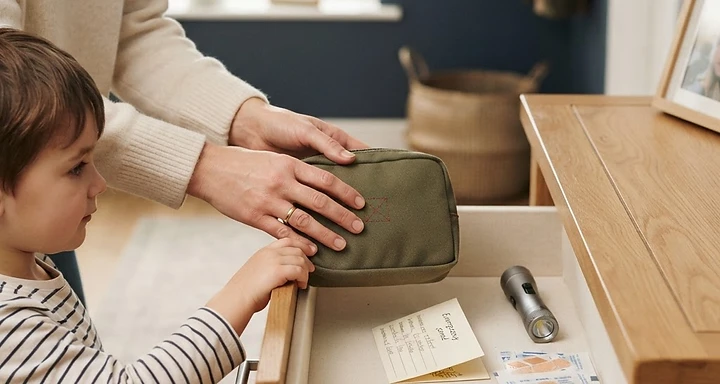
A full emergency kit can be intimidating enough that it never gets built. Start with something small enough to assemble tonight and add to it later.
- A torch with working batteries, checked when the clocks change.
- A charged power bank and a charging cable.
- Copies of ID and insurance, in a plastic sleeve.
- A printed copy of the contact page. Assume no signal.
- Water and a snack that will not expire next month.
- Any regular medication plus a written list of it.
Practise once a season
The batteries, the plan and the phone numbers all decay quietly. One afternoon a season is enough: change the batteries, check the torch, update the contact page for new neighbours and new schools, and re-run the phone script.
Online safety is the same skill
The principle that works for fire drills works for screens: agree the rules while everyone is calm, write them down, and make them mutual. A media agreement that only constrains the child is a rule. One that also lists what the adults promise, such as no phones at dinner and asking before posting a photo, is an agreement, and agreements get followed.
The three age versions of ours are written as two-way promises for exactly that reason.
Free sheets for all of this
Everything mentioned here exists as a free printable in our family safety printables: emergency number posters for each country, a family emergency contacts page, a home fire escape plan, a what-do-I-do-if card set, and media agreements for ages 5 to 13. No sign-up, no email required.
A free read-along and printable for your child’s age
Pick an age band and we’ll send one free read-along story and one free printable for it, plus the My Safe Adults worksheet. Email address only — we never ask for a child’s name.
Get our free 'This book belongs to…' bookplate
Ages 3–5
Ages 6–8
Ages 9–12
Read-along for this band is being chosen. Amazing Me Free Printables — Book 7: Nine and Fearless (Age 9) (PDF)